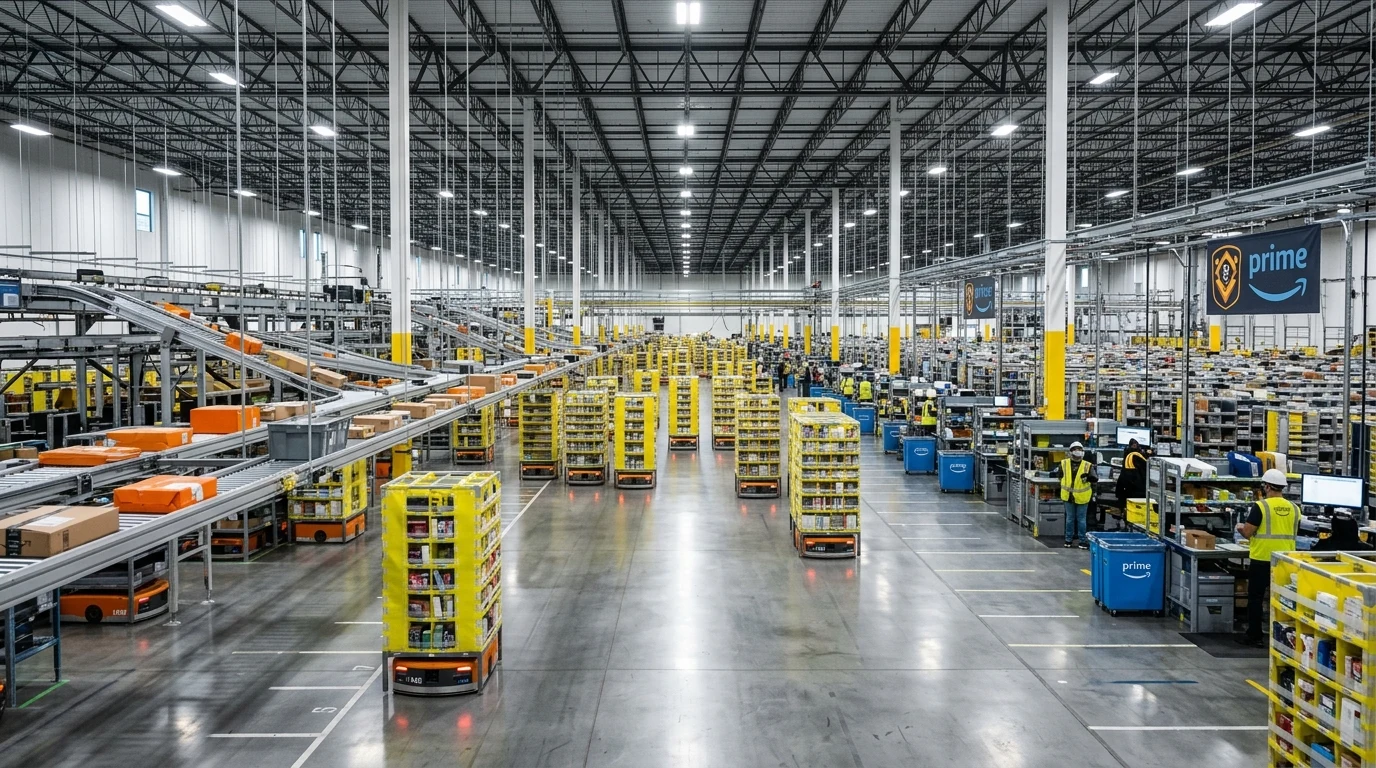
Amazon Prime Distribution Warehouse Guide
✨ This article was AI edited. Editorial responsibility: The Future Warehouse.
In the contemporary e-commerce and supply chain landscape, few logistics networks match the operational scale and precision engineering of an Amazon Prime distribution warehouse. Operating 24/7 across thousands of facilities worldwide, these hubs serve as the backbone of Amazon’s promises of guaranteed next-day and two-day package arrivals. Whether analyzing inbound freight, robotic inventory staging, or last-mile route optimization, understanding the internal mechanics of a Prime distribution center reveals how cutting-edge automation converges with human workflows to move millions of SKUs daily.
Taxonomy of Amazon Logistics Facilities: Centers vs. Delivery Stations
While consumers frequently describe any Amazon facility as a “warehouse,” the Prime distribution ecosystem is strictly divided into specialized functional facility tiers. Each tier executes a distinct phase of the inventory lifecycle, preventing bottlenecks and accelerating freight throughput:
- Inbound Cross-Dock Facilities (IXD): Massive facilities designed to receive bulk truckloads and shipping containers from global vendors, break down pallets, and redistribute goods across fulfillment centers nationwide.
- Fulfillment Centers (FC): The primary storage and pick-pack engines. Non-sortable FCs house large items (furniture, appliances, bulk goods), while sortable FCs utilize Amazon Robotics drive units to manage small-to-medium consumer goods.
- Sortation Centers (SC): Middle-mile routing hubs where packed customer parcels from regional fulfillment centers are consolidated by postal ZIP code and prepared for regional delivery stations or partner carriers like UPS and the United States Postal Service.
- Delivery Stations (DS): The final tier in the Prime pipeline. Located proximate to dense urban and suburban centers, delivery stations sort packages into specific driver delivery routes for Amazon Flex drivers and Delivery Service Partners (DSPs).
- Prime Now & Same-Day Hubs: Compact fulfillment units located directly inside major metropolitan centers, holding high-velocity grocery, household, and consumer electronics SKUs for delivery within 1 to 5 hours.
Core Technological Architecture: How an Amazon Prime Distribution Warehouse Operates
Modern Amazon Prime facilities rely on deep integration between enterprise warehouse management software (WMS), computer vision algorithms, and autonomous mobile robots (AMRs). The facility workflow follows a synchronized five-stage sequence:
1. Inbound Ingestion and Universal Stowing
When trailers dock at inbound receiving bays, items undergo barcode verification and dimension scanning. Unlike traditional warehouses that assign dedicated static bin locations to specific products, Amazon utilizes a proprietary chaotic storage algorithm. Items are stowed in any available bin slot across mobile shelving units called “pods.” This maximizes volumetric density and minimizes the distance robotic units must travel to retrieve high-affinity item combinations.
2. Amazon Robotics Pod Transit
Automated drive units (Hercules and Pegasus class autonomous robots) navigate beneath the yellow multi-tiered pods using QR-code floor matrices and LiDAR sensors. When a customer confirms a Prime order, the warehouse management system directs the robot carrying the target SKU directly to an ergonomic pick station, eliminating unnecessary associate walking time.
3. Vision-Assisted Picking and SLAM Packing
Pickers are guided by digital projection lights indicating the exact pocket containing the SKU. Items are deposited into yellow totes and dispatched onto high-speed automated conveyor belts. Totes route directly to packing lines, where the system calculates optimal cardboard box dimensions, dispenses automated water-activated tape, and feeds parcels into the SLAM (Scan, Label, Apply, Manifest) machine. In less than one second, the SLAM unit scans the package barcode, verifies scale weight against physical tolerances, prints the shipping label, and stamps it onto the parcel.
Comparative Analysis: Amazon Prime Facility Archetypes
To understand capacity and routing differences across the Prime network, the following table delineates technical specifications across facility types:
| Facility Type | Typical Footprint (Sq. Ft.) | Automation Level | Primary Function | Average Processing Cycle |
|---|---|---|---|---|
| Robotic Sortable FC | 800,000 – 1,200,000 | High (AMR Pods, High-Speed Conveyors) | Item Picking, Packaging, and SLAM labeling | 2 to 4 hours from order placement |
| Non-Sortable FC | 1,000,000+ | Moderate (Narrow-Aisle VNA Turret Trucks) | Oversized & Bulky Freight Handling | 4 to 12 hours |
| Regional Sortation Center | 300,000 – 600,000 | High (Linear Shoe Sorters, Robotic Arms) | Middle-Mile Destination ZIP Sorting | 1 to 3 hours |
| Last-Mile Delivery Station | 100,000 – 250,000 | Low-to-Moderate (Buffer Racks & Staging) | Van Loading, Route Sorting, Driver Dispatch | 30 to 90 minutes per dispatch wave |
Energy Management and Environmental Architecture
As logistics operations expand to meet consumer expectations, sustainability in Prime distribution centers has transitioned from an elective CSR metric to an operational engineering requirement. Modern facilities incorporate high-efficiency rooftop photovoltaic (PV) arrays, dynamic occupancy-sensing LED illumination, and closed-loop corrugated cardboard baling systems. Water reclamation systems capture stormwater runoff from vast flat roofs, diverting it toward landscape irrigation and graywater applications.
Furthermore, internal battery staging and charging zones for electric drive units and forklift fleets utilize automated load-balancing switchgear to draw off-peak electrical grid power, preventing grid strain during regional peak industrial load hours.
Strategic Integration with Last-Mile Delivery Networks
The operational success of an Amazon Prime distribution warehouse is measured not by how long goods remain inside, but by how quickly they exit into transit networks. Through deep integration with local dispatch operations, sorting algorithms predict traffic patterns, carrier load capacities, and local weather disruptions hours before line-haul trucks leave the staging dock.
For organizations seeking to optimize internal distribution nodes or benchmark enterprise logistics against industry-leading fulfillment standards, exploring specialized workflows such as distribution center employment structures and package transit timing variables provides critical comparative context.
Frequently Asked Questions Regarding Amazon Prime Distribution Warehouses
Can members of the public pick up packages directly from an Amazon Prime distribution warehouse?
Generally, no. Amazon Prime distribution warehouses, fulfillment centers, and sortation facilities are high-security industrial zones closed to walk-in public access. Package pickups are only supported at designated consumer-facing access points such as Amazon Lockers, Amazon Hub Counters in retail partner stores, or dedicated public customer service pickup desks at select metropolitan delivery stations.
What is the difference between an Amazon Fulfillment Center and an Amazon Delivery Station?
An Amazon Fulfillment Center focuses on receiving, storing inventory, and packing individual customer orders. An Amazon Delivery Station does not store long-term inventory; instead, it receives pre-packed customer parcels from fulfillment and sortation centers and organizes them into specific van delivery routes for last-mile delivery.
How do Amazon Prime warehouses achieve same-day order processing?
Same-day fulfillment relies on autonomous mobile robotics (AMRs) that bring inventory directly to associates, chaotic storage algorithms that reduce travel times, real-time demand-sensing inventory placement in urban mini-hubs, and automated SLAM machines that weigh, verify, and label packages in under one second.
Get our latest guides, news, and insights highlighted in your Google Search & AI Overviews.