Walmart Warehouse Management System (WMS) Guide
✨ This article was AI edited. Editorial responsibility: The Future Warehouse.
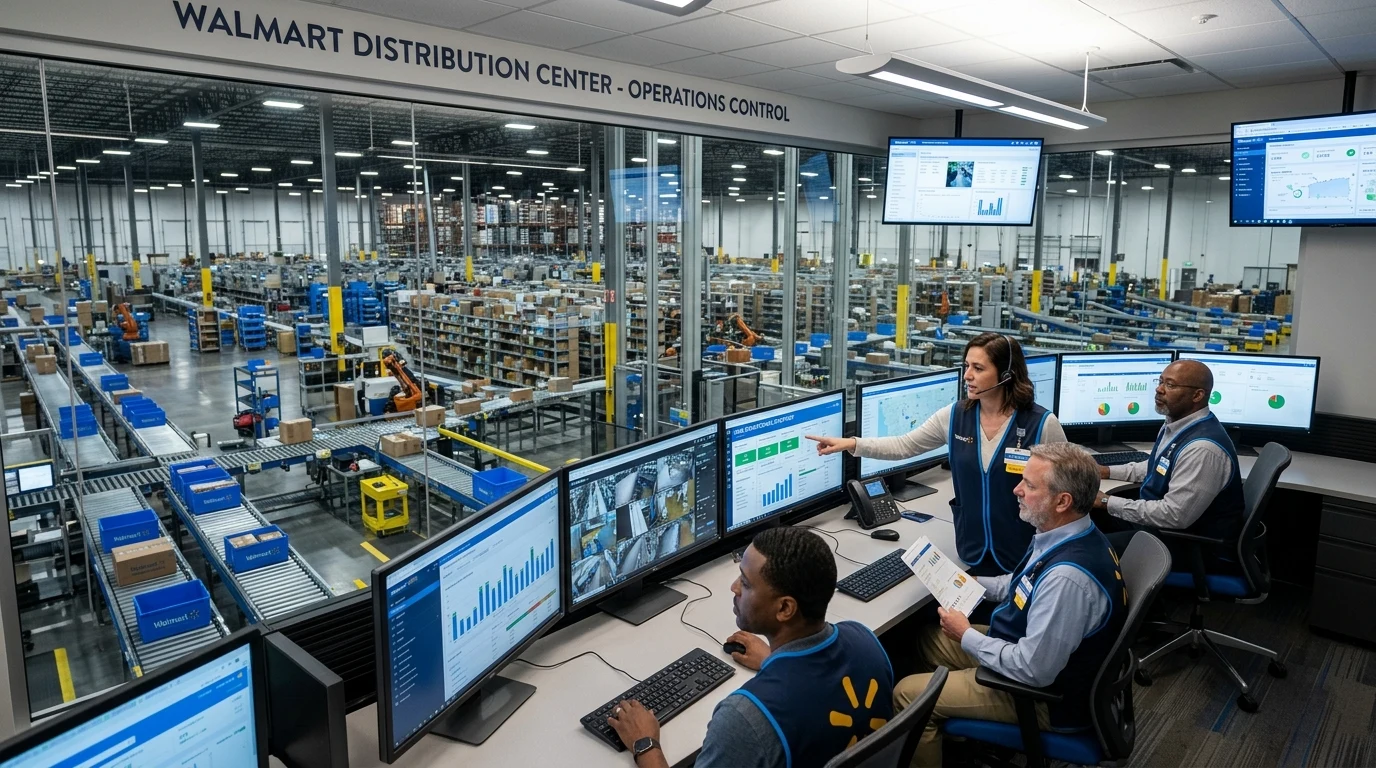
Operating at an unprecedented retail scale, Walmart’s supply chain is widely studied as a global standard for inventory velocity, cross-dock efficiency, and distribution automation. Across more than 150 regional distribution centers, high-velocity grocery facilities, and next-generation fulfillment centers in North America, Walmart warehouse management relies on algorithmic task interleaving, automated guided vehicles (AGVs), and machine-learning inventory replenishment engines to supply thousands of retail stores and fulfill millions of online orders daily.
The Evolution of Walmart’s Warehouse Management Systems (WMS)
Walmart’s logistics dominance originated in the 1970s and 1980s under Sam Walton, who pioneered direct cross-docking and established proprietary satellite communications (the largest private satellite network in the world at the time) to track store sales in real time. Over the ensuing decades, Walmart’s WMS software architecture evolved across distinct operational eras:
- Legacy Mainframe Logistics (GLS): Centralized mainframe architectures managing static batch-processed purchase orders and paper pick lists.
- Radio Frequency (RF) Directed Operations: Deployment of handheld barcode scanners and vehicle-mounted terminals that introduced dynamic pick-to-voice, automated slotting algorithms, and real-time forklift tracking.
- The Automated High-Tech DC Transformation: Modern multi-tiered software platforms that integrate edge computing, IoT telemetry from conveyance belts, and artificial intelligence into cloud-synchronized warehouse execution systems (WES).
Core Technological Pillars of Modern Walmart Warehouse Management
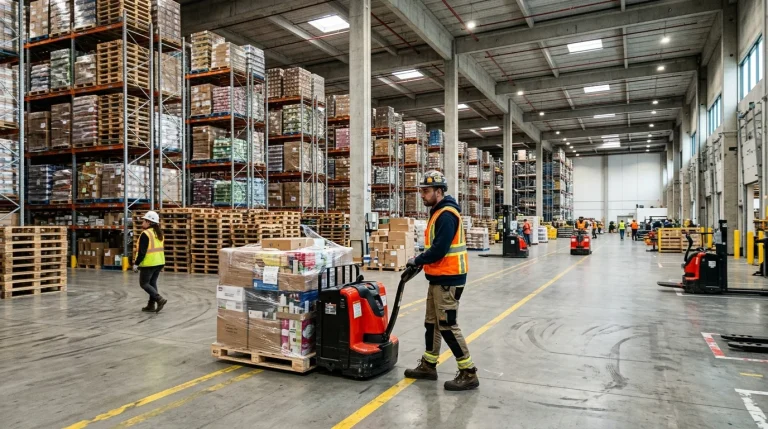
Modern Walmart distribution facilities differ fundamentally from traditional manual rack-and-forklift warehouses. Automation and software coordinate five primary physical subsystems:
1. Symbotic High-Density Robotic Automation
In partnership with robotics technology provider Symbotic, Walmart has systematically automated its regional general merchandise distribution centers. The system utilizes autonomous mobile fleets of high-speed rovers that traverse multi-level storage grid matrices at speeds up to 25 mph. Rovers store, retrieve, and sequence individual cartons with millimeter precision, eliminating traditional manual aisle forklift travel.
2. Algorithmic Palletization and Store-Friendly Pallets
One of the greatest operational friction points in retail logistics is store-level restocking. Traditional warehouses stack pallets based on warehouse bin proximity, forcing retail store associates to haul pallets across entire store footprints. Walmart’s modern WMS utilizes complex structural algorithms to assemble “store-friendly pallets”—building custom pallet loads sequenced specifically to match the unique aisle-by-aisle commodity layout of each destination Supercenter.
3. Cross-Docking Without Putaway Staging
Cross-docking remains the heartbeat of Walmart’s inventory velocity. When inbound trailers arrive at receiving docks, barcode scanners read GS1-128 shipping container labels. If an inbound product has active store demand, the WMS directs automated sorters to bypass storage racks entirely, sending pallets or cases directly to outbound staging doors where trailers are loaded for same-day store departure.
Comparative Analysis: Traditional WMS vs. Walmart High-Tech WMS
The technical differences between conventional enterprise warehousing and Walmart’s automated distribution methodology are detailed in the comparative matrix below:
| System Dimension | Traditional Enterprise WMS | Walmart High-Tech Autonomous WMS | Operational Advantage |
|---|---|---|---|
| Case Ingestion | Manual pallet jack or forklift unloading | Automated depalletizing robotic arms | 4x faster dock-to-stock cycle times |
| Pallet Assembly | Manual human pickers on pallet jacks | Automated Symbotic algorithmic palletizers | Zero product crushing; aisle-sequenced |
| Inventory Visibility | Periodic batch cycle counting | Real-time continuous sensor & vision telemetry | 99.8%+ inventory record accuracy |
| Floor Space Utilization | Standard wide aisles for reach trucks | High-density vertical automated storage grids | Doubles storage capacity within same building footprint |
Labor Coordination, Ergonomics, and Associate Workflows
A central misconception of advanced warehouse automation is the complete elimination of human labor. At Walmart, automation has transformed warehouse jobs from manual, repetitive heavy lifting into technical supervisory and equipment-operating roles. Associates transition into positions such as Automation Systems Technicians, Mechatronics Specialists, Yard Coordinators, and Quality Assurance Analysts.
Ergonomic workstations feature automated height-adjusting lift tables, intuitive touchscreen interfaces displaying multi-lingual work instructions, and ambient safety laser curtains that immediately pause mechanical motion if personnel enter active robot operational perimeters.
Synergies with Upstream Vendors and Downstream Stores
The true power of Walmart warehouse management lies in its seamless data connectivity with both ends of the supply chain. Through Walmart’s Retail Link portal and automated EDI pipelines, suppliers have immediate visibility into point-of-sale (POS) sell-through rates, distribution center inventory reserves, and automated purchase order generation.
For supply chain analysts and warehouse executives exploring comparative logistics frameworks, reviewing related operational directives such as Walmart warehouse alignment codes, distribution center staffing structures, and Amazon automated fulfillment models provides essential strategic benchmarking.
Frequently Asked Questions Regarding Walmart Warehouse Management
What warehouse management software does Walmart use?
Walmart utilizes a proprietary, custom-engineered warehouse management and execution platform developed in-house by Walmart Global Tech, deeply integrated with the Symbotic robotics control platform and enterprise SAP back-office systems.
What are “store-friendly pallets” in Walmart distribution?
Store-friendly pallets are custom-assembled pallets built by automated robotic palletizers that group and sequence merchandise specifically by department and physical aisle layout, allowing store associates to unpack and stock store shelves directly without re-sorting.
How does Walmart manage cross-docking in its regional distribution centers?
When trucks unload at receiving bays, the WMS identifies pre-allocated merchandise and routes it via high-speed automated conveyor sorters directly across the warehouse floor to outbound shipping bays, loading goods onto store trailers without long-term shelf storage.
Get our latest guides, news, and insights highlighted in your Google Search & AI Overviews.