Ferdinand II of Aragon: Maritime Warehousing & Trade
✨ This article was AI edited. Editorial responsibility: The Future Warehouse.
While mainstream historical scholarship primarily examines King Ferdinand II of Aragon through the prism of the Spanish Reconquista, the unification of the Crowns of Castile and Aragon with Queen Isabella I, and European dynastic diplomacy, his administrative legacy in commercial logistics is equally profound. Ruling over the maritime mercantile empire of the Crown of Aragon—encompassing Catalonia, Valencia, the Balearic Islands, Sicily, and Naples—Ferdinand recognized that geopolitical dominance required the systematic regulation of storage facilities, commodity quality verification, and secure trade transit corridors.
The Maritime Commercial Architecture of the Crown of Aragon
Unlike the agrarian, land-oriented economy of inland Castile, the Crown of Aragon was a formidable seafaring commercial confederation. For centuries prior to Ferdinand’s ascension, merchants from Barcelona, Valencia, and Palma de Mallorca had established trading factories (fondacos or alhóndigas) across North Africa, the Levant, and the Byzantine Mediterranean. These early establishments combined warehouse storage, sleeping quarters for foreign merchants, customs offices, and religious sanctuaries under chartered consular protection.
Upon consolidating his rule, Ferdinand instituted reforms to modernize and protect these logistical nodes:
- Codification of the Consolat de Mar: Ferdinand reinforced and promulgated the Consulate of the Sea, the preeminent medieval maritime law code governing charter parties, shipmaster liabilities, jettison compensation, and warehouse cargo damage claims.
- The Expansion of the Lonjas: Ferdinand patronized the completion and operational formalization of civil mercantile exchanges, most notably the Gothic Lonja de la Seda (Silk Exchange) in Valencia. These architectural masterpieces served not merely as meeting halls, but as secured inventory appraisal vaults where silk, wool, spices, and precious metals were officially weighed, graded, and stored under municipal notary supervision.
- Standardization of Tariffs and Royal Customs (Aduanas): By establishing uniform transit tolls (*lezdagium*) across Aragon’s ports, Ferdinand reduced internal transit friction while capturing predictable customs revenues to fund naval escorts against Barbary corsairs.
The Co-Creation of the Casa de la Contratación (1503)
Following Christopher Columbus’s transatlantic voyages—which Ferdinand co-sponsored—the Spanish Crown faced an unprecedented logistics challenge: how to regulate, tax, and inventory an influx of gold, silver, dyewoods, and tobacco from the New World while controlling the outbound flow of emigrants, arms, and European manufactured goods.
In response, Ferdinand and Isabella signed the royal decree of January 20, 1503, founding the Casa de la Contratación de las Indias in Seville. The Casa operated as Europe’s first centralized institutional trade regulator, functioning simultaneously as:
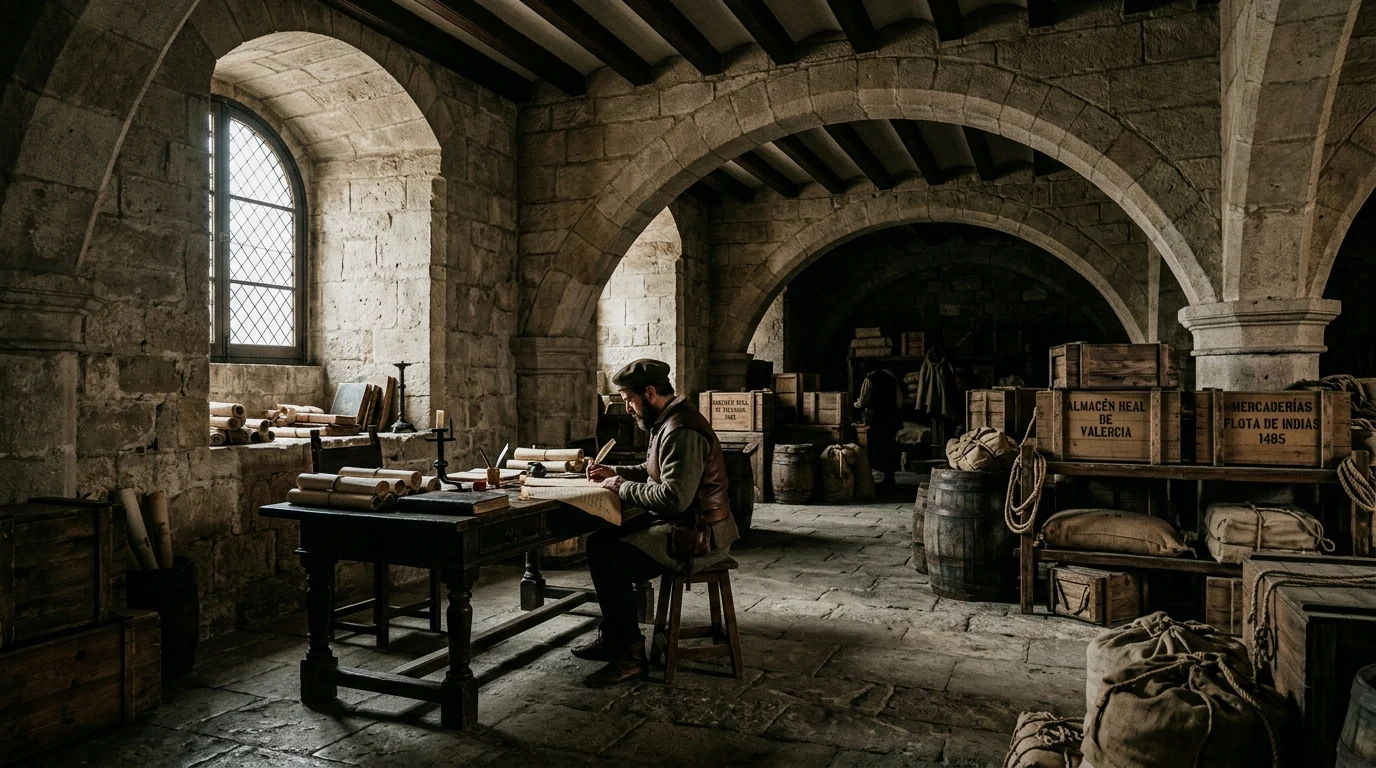
- A Monopolistic Customs Warehouse: All maritime cargo bound for or arriving from the Americas was legally mandated to pass through the Casa’s secure riverside storage vaults at the Alcázar of Seville. Unregistered cargo was seized as contraband.
- A Scientific Hydrographic & Cartographic Bureau: The Casa appointed the *Piloto Mayor* (including Amerigo Vespucci and Juan Díaz de Solís) to maintain the *Padrón Real*—the secret master navigation chart of the Atlantic.
- A Commercial Judiciary: Specialized magistrates adjudicated maritime disputes, breach of shipping contracts, cargo spoilage, and maritime insurance fraud without appeal to common municipal courts.
Technical Comparison: Medieval Mercantile Nodes vs. Royal Regulated Warehouses
The administrative evolution from decentralized municipal trade stalls to royal centralized logistics depots under Ferdinand’s policies is outlined in the comparative table below:
| Logistics Dimension | Pre-Ferdinand Municipal Fondaco | Ferdinandian Royal Customs / Lonja System | Modern Supply Chain Equivalent |
|---|---|---|---|
| Regulatory Authority | Local merchant guild or city council | Royal Crown oversight via chartered consulates | National Customs & Border Protection (CBP) |
| Inventory Verification | Informal inspection by buyer/seller | Sworn royal weighers (*pesadores*) and assayers | Third-Party Quality Assurance / ISO Certification |
| Security & Bailment | Private merchant watchmen | Royal armed guards with bonded storage locks | Bonded Warehouse (CFS / FTZ facilities) |
| Cargo Tracking | Single merchant ledger books | Dual-notarized shipping manifests & royal registries | Automated EDI 856 / Electronic Bills of Lading |
Postal Relays, Royal Correo, and Information Routing
Managing extensive territories spanning the Iberian Peninsula, the Kingdom of Sicily, and Southern Italy required reliable logistics intelligence. Ferdinand realized that physical cargo movements were useless without concurrent administrative data. In 1501, Ferdinand and Isabella appointed Francisco de Tassis as *Correo Mayor* (Postmaster General), creating an integrated trans-European royal dispatch network.
Operating through predetermined post stages (*postas*) spaced 15 to 20 miles apart where riders could switch exhausted horses, royal dispatches could travel from Toledo to Brussels or Naples in record time. This information pipeline allowed Ferdinand’s ministers to anticipate grain shortages, re-route supply ships, and adjust customs duties dynamically across regional maritime ports.
Historical Precedents for Contemporary Enterprise Logistics
Modern supply chain managers often view automated inventory tracking, bonded foreign trade zones (FTZs), and cross-docking as 21st-century innovations. However, the foundational principles of bonded custody, standardized shipping documentation, and centralized hub-and-spoke distribution were codified half a millennium ago under the economic statecraft of Ferdinand II of Aragon.
For modern supply chain professionals examining the evolution of distribution networks, exploring historical frameworks alongside modern case studies—such as contemporary Amazon distribution logistics and enterprise retail inventory alignment—illustrates the timeless imperative of inventory visibility and transit efficiency.
Frequently Asked Questions Regarding Ferdinand II of Aragon’s Trade Reforms
How did Ferdinand II of Aragon influence early warehouse storage systems?
Ferdinand formalized the legal framework for maritime bonded warehouses, standardized consular inspection scales, and expanded royal customs houses throughout the Mediterranean ports of Valencia, Barcelona, and Naples, ensuring goods were protected under statutory maritime law.
What was the role of the Casa de la Contratación established in 1503?
Established by Ferdinand and Isabella in 1503, the Casa de la Contratación served as a royal warehouse and commercial clearinghouse that controlled, taxed, and monitored all transatlantic goods, ships, and passengers traveling between Spain and the Americas.
What was the significance of the Consulate of the Sea under Aragonese rule?
The Consulate of the Sea (*Consolat de Mar*) was the preeminent medieval maritime legal code recognized across Mediterranean ports. Ferdinand confirmed its authority to govern merchant dispute resolution, cargo liability, and warehousing agreements.
Get our latest guides, news, and insights highlighted in your Google Search & AI Overviews.