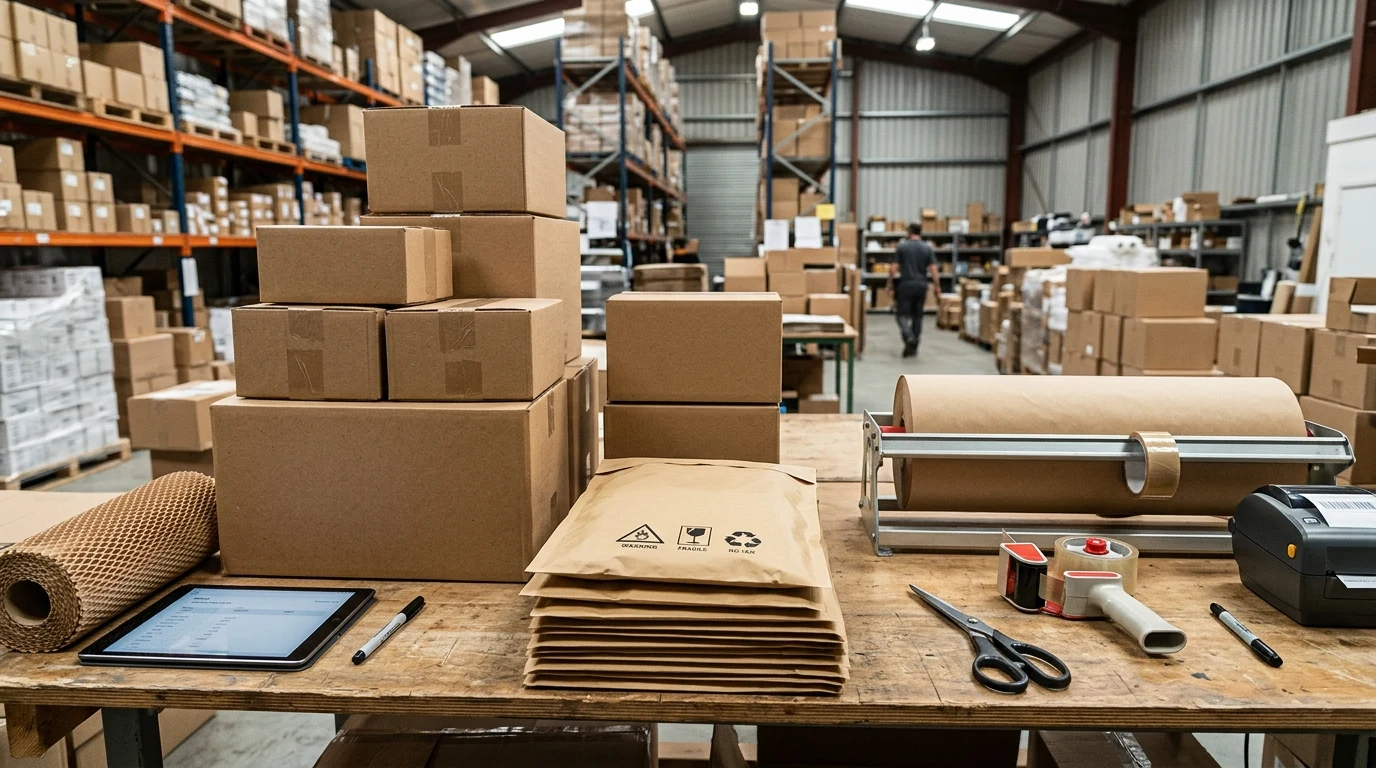
Amazon Packaging Material for Sellers: The Complete FBA Prep, Poly Bag & Box Standards Guide
✨ This article was AI edited. Editorial responsibility: The Future Warehouse.
Sellers preparing inventory for Amazon Fulfillment by Amazon (FBA) and Seller Fulfilled Prime (SFP) must adhere to rigorous packaging material specifications, dunnage restrictions, poly bag suffocation warnings, and box bursting test thresholds. Failing to meet Amazon’s strict packaging guidelines results in receiving delays, mandatory FBA unplanned prep service fees, inventory refusal at inbound cross-docks, or damaged customer returns that harm seller account health metrics.
Overview of Amazon FBA Inbound Packaging Standards
When merchandise arrives at an Amazon fulfillment center, it undergoes high-speed conveyor sorting, automated scanning, and robotic pod storage. To withstand multi-tier mechanical handling, packaging materials must satisfy strict structural durability and safety criteria:
- Master Shipping Cartons (Outer Boxes): Must be constructed from standard rigid corrugated cardboard with an Edge Crush Test (ECT) rating of at least 32 lbs/in or a Bursting Test (Mullen) rating of 200 lbs/sq inch. Six-sided rectangular boxes are required.
- Weight & Dimension Limitations: Standard carton dimensions must not exceed 25.0 inches on any single side unless containing a single oversize unit. Gross carton weight must not exceed 50.0 lbs without a “Team Lift” warning label (or 100.0 lbs for “Mech Lift”).
- Sealing & Tape Standards: Heavy-duty pressure-sensitive plastic packaging tape, water-activated reinforced gummed paper tape (Kraft tape), or heavy heat-seal straps. Masking tape, duct tape, cellophane tape, and string/twine are strictly prohibited.
Approved vs. Prohibited Dunnage & Void Fill Materials
Dunnage protects products from shifting inside shipping cartons during intermodal transportation. Amazon enforces strict void fill regulations:
| Dunnage / Void Fill Material | Amazon FBA Approval Status | Operational Guidelines |
|---|---|---|
| Inflatable Air Pillows / Cushions | Approved (Highly Recommended) | Clean, lightweight, fully recyclable polyethylene film. |
| Brown Kraft Paper / Packing Paper | Approved (Standard) | Heavyweight crumpled unprinted kraft paper filling open void space. |
| Bubble Wrap (Small & Large Cell) | Approved | Minimum 1/4″ thickness for fragile glassware, ceramics, and electronics. |
| Polyethylene Foam Sheeting | Approved | Non-abrasive surface protection for scratch-sensitive metal or polished plastics. |
| Styrofoam Packing Peanuts / Loose Fill | Strictly Prohibited | Causes severe jams in automated sorter conveyor belts and optical sensors. |
| Shredded Paper / Crinkle Cut Paper | Strictly Prohibited | Creates dust hazards and spills across automated picking decks. |
| Thermocol Blocks / Foam Flakes | Strictly Prohibited | Fragile foam breaks into static clinging debris inside fulfillment pods. |
Poly Bag Specifications & Suffocation Warning Requirements
Poly bagging is mandatory for plush toys, textile apparel, loose sets, and liquid bottles prone to leakage. Amazon enforces strict poly bag regulations:
1. Suffocation Warning Label Mandate
Any poly bag with an opening of 5 inches or wider (measured when laid flat) must display a clear, legible suffocation warning label printed in bold typeface or attached as an exterior label:
“WARNING: To avoid danger of suffocation, keep this plastic bag away from babies and children. Do not use this bag in cribs, beds, carriages, or playpens. This bag is not a toy.”
2. Type Size Requirements by Bag Dimension
- Total length + width of bag 60 inches or more: 24-point font minimum.
- Total length + width of bag 40 to 59 inches: 18-point font minimum.
- Total length + width of bag 30 to 39 inches: 14-point font minimum.
- Total length + width of bag less than 29 inches: 10-point font minimum.
3. Thickness and Transparency Rules
Poly bags must have a minimum thickness of 1.5 mils (0.0015 inches) to prevent punctures. Bags must be transparent to allow warehouse barcode scanners to read item FNSKU barcodes directly through the film.
FNSKU Barcode Labeling & Thermal Printing Best Practices
Every unit sent into FBA requires an scannable FNSKU (Fulfillment Network Stock Keeping Unit) barcode or manufacturer UPC barcode:
- Direct Thermal vs. Thermal Transfer Labels: For long-term storage, Thermal Transfer labels printed with wax-resin ribbons are strongly recommended over Direct Thermal paper, which darkens and fades when exposed to hot warehouse trailers.
- Label Placement & Coverage: Place FNSKU labels flat across smooth exterior surfaces. Never place labels over box corners, curves, seams, or openings. Cover existing manufacturer UPC barcodes entirely to prevent dual-scan receiving errors.
Packaging Specialized Product Categories: Liquids, Fragile & Bundles
Liquids, Pastes & Gels (Double-Sealing Protocol)
Liquid containers must withstand a 3-foot drop test onto concrete without leaking. Bottles with screw caps require an induction seal, heat-shrink safety neck band, or sealed poly bag containment capable of holding the entire fluid volume.
Fragile & Glassware (Drop-Test Compliance)
All fragile units must be packaged inside a rigid six-sided protective inner box wrapped in dense bubble wrap and capable of passing a 1-meter drop test onto all six sides, corners, and edges without breakage.
Multipacks and Bundles (“Sold as Set” Labels)
Units sold as multi-packs (e.g., 3-pack shampoo, bundled hardware) must be shrink-wrapped or boxed together with a highly visible fluorescent label reading: “Sold as Set – Do Not Separate” or “Ready to Ship” to prevent warehouse decanting associates from breaking the set apart.
Eco-Friendly Packaging & Amazon Ships in Product Packaging (SIPP)
Amazon incentivizes sellers through its Ships in Product Packaging (SIPP) program (formerly SIOC). Products certified to ship in their custom branded box without an outer Amazon cardboard box receive substantial FBA fulfillment fee discounts (typically $0.04 to $0.58 per unit) and reduce consumer packaging waste.
Related Logistics, Packaging & Warehouse Guides
To master inbound logistics, fulfillment center architectures, and inventory workflows across global e-commerce supply chains, explore our related guides on how to find your Amazon FBA warehouse address, Amazon greenfield fulfillment center layouts, and industrial aseptic packaging methods.
Conclusion
Mastering Amazon FBA packaging materials and prep standards protects your inventory against physical transit damage, eliminates unexpected inbound prep penalty fees, and ensures immediate receiving at Amazon fulfillment centers nationwide.
Get our latest guides, news, and insights highlighted in your Google Search & AI Overviews.