Warehouse USA: The Complete Guide to American Commercial Logistics, 3PL Hubs & Industrial Real Estate
✨ This article was AI edited. Editorial responsibility: The Future Warehouse.
The United States industrial warehousing sector encompasses more than 15 billion square feet of commercial logistics real estate, serving as the physical backbone for domestic retail distribution, cross-border e-commerce, third-party logistics (3PL), cold-chain grocery fulfillment, and advanced automated manufacturing. From the sprawling Inland Empire of Southern California and the Dallas-Fort Worth mega-logistics triangle to the Lehigh Valley freight corridor and Savannah port logistics clusters, selecting the ideal geographic warehousing footprint dictates supply chain transit speeds, transportation linehaul costs, and final-mile customer satisfaction.
Macroeconomic Drivers Shaping the US Warehousing Landscape
Modern commercial warehousing in the United States is defined by structural shifts in omnichannel consumer demand, supply chain reshoring, and high-velocity automation:
- Next-Day and Same-Day Delivery SLAs: Consumers expect rapid parcel transit, compelling enterprise retailers and e-commerce platforms to decentralize inventory across regional micro-fulfillment and sub-same-day nodes.
- Nearshoring & Domestic Manufacturing: Increased domestic fabrication in high-tech sectors (semiconductors, electric vehicle batteries, aerospace) has spurred massive demand for specialized Class-A industrial storage adjacent to interstate highway junctions and rail intermodal yards.
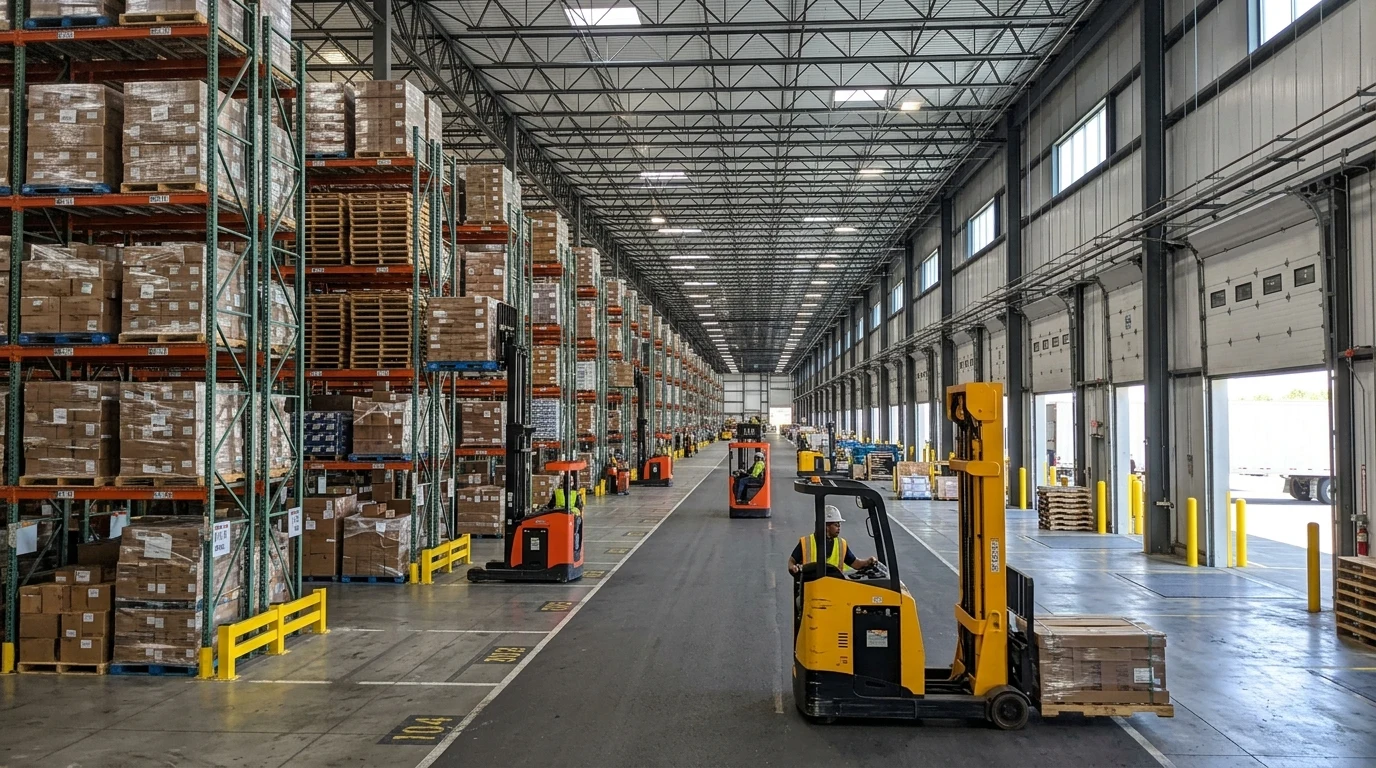
- Automation Integration: Modern Class-A industrial developments feature 36-to-40-foot clear ceiling heights, super-flat industrial concrete floors (FF/FL numbers > 50), reinforced roof trusses for automated overhead cranes, and heavy 4,000+ amp three-phase power infrastructure to support Autonomous Mobile Robots (AMRs) and Automated Storage and Retrieval Systems (ASRS).
Major US Warehousing and Logistics Corridors
The following structured matrix compares the premier commercial warehousing clusters across the United States:
| Logistics Region / Submarket | Primary Geographic Advantage | Average Clear Height | Primary Freight Gateways | Key Industry Sectors |
|---|---|---|---|---|
| Inland Empire (Southern California) | Immediate proximity to the Ports of Los Angeles & Long Beach (40% of US imports) | 36′ – 40′ | I-10, I-15, BNSF / Union Pacific Intermodal Ramps | Consumer Electronics, Retail, Apparel, 3PL |
| Dallas-Fort Worth (DFW Metroplex) | Central US crossroads enabling 48-hour truck delivery to 93% of the continental US | 32′ – 40′ | I-35, I-20, DFW International Airport, Alliance Texas | E-Commerce Distribution, Heavy Machinery, CPG |
| Lehigh Valley / Central Pennsylvania | Gateway to the dense Northeast consumer megalopolis (New York, Philadelphia, Boston) | 32′ – 36′ | I-78, I-81, Port of New York & New Jersey | Food & Beverage, Pharmaceuticals, Retail |
| Atlanta / Savannah Corridor (Southeast) | Fastest-growing container port on the East Coast with direct Class-I rail links | 32′ – 36′ | I-75, I-85, I-95, Port of Savannah (Garden City) | Automotive Assembly, Home Goods, Cold Chain |
| Chicago / I-80 Corridor (Midwest) | Nation’s largest rail intermodal hub connecting East and West coast freight routes | 30′ – 36′ | I-80, I-55, O’Hare Air Cargo, BNSF Logistics Park | Industrial Manufacturing, Automotive, Food Grade |
Industrial Real Estate Lease Structures: NNN vs. Modified Gross
Navigating commercial industrial real estate contracts in the US requires understanding financial lease structures and cost allocations:
- Triple Net (NNN) Leases: The industry standard for Class A distribution centers. The tenant pays a base monthly rental rate plus all real estate property taxes, building insurance, and Common Area Maintenance (CAM) operational fees.
- Modified Gross Leases: Common in multi-tenant industrial business parks where the landlord covers base taxes and insurance, with the tenant responsible for interior utilities and incremental tax escalations.
- Tenant Improvement (TI) Allowances: Landlord capital contributions allocated toward installing heavy electrical transformer upgrades, high-velocity low-speed (HVLS) warehouse fans, dock levelers, and office administrative spaces.
Class A vs. Class B vs. Class C Industrial Warehouses
Commercial warehouse properties in the United States are categorized into three distinct architectural and functional classes:
1. Class A Warehousing (State-of-the-Art Logistics)
Constructed within the last 10–15 years, Class A buildings feature 32′ to 40′ clear ceiling heights, 50′ × 50′ column spacing, ESFR (Early Suppression Fast Response) fire sprinkler systems, 130-foot deep truck courts, 1 dock door per 10,000 sq ft, and extensive trailer parking drops.
2. Class B Warehousing (Functional Mid-Tier Storage)
Typically 15–30 years old with 24′ to 30′ clear heights. Well-maintained and functionally suited for regional manufacturers, local distribution distributors, and value-added assembly operations.
3. Class C Warehousing (Legacy Storage & Flex Space)
Older facilities (>30 years) with clear heights below 22′, limited dock positions, and narrower column spacing. Commonly utilized for dead storage, local contractor flex units, or heavy mechanical repair yards.
Third-Party Logistics (3PL) vs. Dedicated Self-Managed Warehousing
Companies scaling their US physical distribution evaluate two primary operating models:
- Shared / Multi-Tenant 3PL Facilities: Pay-as-you-go pricing based on pallet storage positions and pick-and-pack transaction counts. Eliminates long-term lease liabilities and capital expenditure on racking and forklifts.
- Dedicated Build-to-Suit / Triple-Net (NNN) Leases: Long-term (5 to 15-year) leases granting complete operational control over warehouse management systems (WMS), bespoke automation machinery, and proprietary inventory workflows.
Environmental Sustainability & Green Warehousing Trends
Leading industrial developers (e.g., Prologis, Goodman, Link Logistics) increasingly integrate LEED-certified sustainability standards into US facilities:
- Rooftop Solar PV Arrays: Generating megawatts of on-site clean renewable electricity to power electric forklift fleets and grid feed-in.
- High-Efficiency LED Smart Motion Lighting: Reducing warehouse electrical consumption by up to 65% compared to legacy metal-halide fixtures.
- Cool Roof Reflective Membranes (TPO): Mitigating heat island effects and lowering refrigeration cooling loads inside temperature-controlled storage spaces.
Related Industrial Supply Chain & Logistics Guides
To deepen your understanding of modern distribution center engineering and logistics best practices, explore our specialized guides on greenfield fulfillment center architecture, Amazon nationwide warehouse directory and facility codes, and advanced warehouse automation and robotics.
Conclusion
The US commercial warehousing market is experiencing unprecedented modernization. By strategically locating facilities along core freight corridors, deploying Class-A automation-ready infrastructure, and leveraging scalable 3PL partners, enterprises build resilient, cost-efficient distribution networks capable of thriving in today’s rapid e-commerce economy.
Get our latest guides, news, and insights highlighted in your Google Search & AI Overviews.