Back Support for Warehouse Workers (Avoid These!)
Did you know that manual material handling remains the leading catalyst for occupational musculoskeletal disorders in modern distribution centers?source As the physical demands of logistics accelerate, relying on outdated lumbar compression belts is no longer a viable strategy for preventing workplace injuries. Effective back support for warehouse workers requires a complete paradigm shift. Rather than simply wrapping your core in elastic, adopt a forward-looking approach that integrates advanced ergonomic safety gear with proper lifting mechanics and strict OSHA standards. Prioritize holistic spinal health and actionable repetitive strain reduction to protect your longevity on the floor while avoiding the critical traps of traditional bracing solutions.

The Modern Standard for Back Support for Warehouse Workers
When implementing these devices in today’s logistics environments, you must define their exact function. In a modern context, they provide supplemental postural cues and mild abdominal pressure during lifting tasks rather than acting as a rigid structural frame. The industry consensus has shifted, emphasizing that physical supports must be integrated into a broader ergonomic strategy; they should never serve as a standalone solution for injury prevention.
Medical vs. Job-Specific Belts
To optimize your safety protocols, differentiate between medical interventions and occupational gear. Traditional orthopedic bracing is strictly intended for individuals recovering from existing spinal injuries, offering aggressive immobilization. Conversely, job-specific lumbar compression belts provide gentle proprioceptive feedback to remind you to maintain proper spinal alignment. While these occupational belts offer temporary awareness, they cannot correct poor biomechanics or replace an optimized Consolidation in Warehousing: Worth It? [Data].
The Danger of False Security
Relying heavily on generic equipment creates a hazardous false sense of security. When you wear these supports, you might unconsciously attempt to lift loads exceeding your safe physical capacity, mistakenly believing the belt provides invulnerability. OSHA and NIOSH consistently state that these belts should never replace safe lifting techniques or act as your primary preventative measure. Your long-term health relies on rigorous OSHA Warehousing Safety 2026 [Fast 5-Min Guide], not merely strapping on a belt.
Having clarified the scope of these tools, we now examine the specific physical movements that define safe material handling.
Mastering Lifting Mechanics and Biomechanics
Understanding the precise biomechanics of human movement is essential before you rely on any support aid. Using external devices without addressing foundational movement often creates a dangerous false sense of security. By mastering proper lifting mechanics, you actively reduce the shear forces that degrade spinal health. Review the structural breakdown below to fully visualize how spinal physics interact with heavy daily loads:

Optimizing manual handling tasks drastically decreases your risk of injury. Implement these fundamental movement principles into your routine:
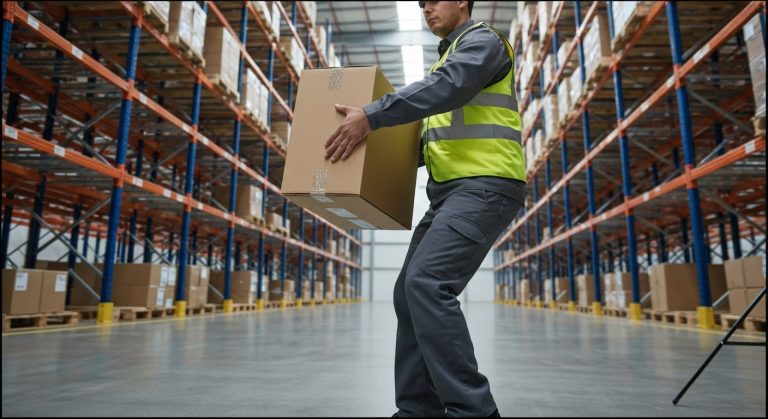
- Control load proximity: The physical science of leverage dictates that holding a heavy box directly against your torso minimizes the fulcrum effect. Keeping inventory close to your center of gravity significantly reduces the overall vertebral load during every lift, as highlighted by national workplace safety standards.
- Pivot instead of twisting: Rotating the spine under tension is one of the most dangerous maneuvers in material handling. Always pivot your feet to change direction rather than twisting your torso, which aggressively strains lumbar discs.
- Execute deliberate posture correction: Repetitive strain reduction is fundamentally achieved through active posture correction before initiating a heavy lift. Ensure your shoulders are squared and your hips are hinged backward.
- Commit to kinetic alignment: Establishing a wide base allows your leg muscles to drive the upward momentum. This structural alignment perfectly complements standard LPN in Warehousing: What Is It? (No Jargon!) and OSHA Warehousing Safety 2026 [Fast 5-Min Guide].
Having mastered your personal mechanics, you must now ensure your workstation environment reinforces these healthy habits.
Ergonomic Workstation Design and Technology
Facility design and engineering controls are your most effective tools to proactively minimize occupational musculoskeletal disorders. By engineering risks out of the environment, you establish a baseline of true industrial safety. For example, integrating height-adjustable tables and packing stations allows you to match the physical setup directly to individual worker ergonomics, preventing the awkward postures that drive chronic pain.
Additionally, for personnel who spend hours standing during manual material handling operations, deploying anti-fatigue mats is essential. These surfaces encourage subtle leg movements that relieve lower back compression. Further review our 11 night shift tips for amazon warehouse workers for complementary layout ideas. See the example here:

Finally, the integration of automated lifting aids and mechanical hoists serves as the ultimate support mechanism. By deploying these tools for heavy transfers, you often eliminate the need for traditional external braces entirely. Implementing these physical upgrades, as recommended by ergonomic engineering guidelines, protects your workforce from acute injuries while optimizing daily throughput.
With an optimized physical environment in place, the final step involves fostering the operational culture necessary to maintain these safety gains.
Training, Job Rotation, and Risk Assessment
While physical tools play a vital role, sustainable workplace injury prevention requires a systemic approach to how your team operates daily. By structuring your operational protocols with human biomechanics in mind, you can drastically reduce the daily physical toll on your workforce.
- Implement Comprehensive Education: You must establish formalized lifting safety training for distribution centers. Moving far beyond basic onboarding, this ongoing curriculum should teach employees how to navigate complex, asymmetrical loads dynamically. When you prioritize education over merely issuing standard equipment, you build a resilient workforce capable of making smart physical decisions on the floor.
- Enforce Dynamic Job Rotation: Sticking to a static shift assignment inevitably accelerates musculoskeletal wear. Implementing strict job rotation schedules prevents localized muscle fatigue and repetitive strain injuries. By systematically rotating personnel across different functional zones every few hours, you allow specific muscle groups to rest and recover, minimizing the cumulative damage that often leads to chronic joint issues.
- Execute Holistic Hazard Evaluations: A robust safety architecture demands continuous auditing. Conduct a holistic risk assessment for all repetitive movements, looking far beyond the isolated action of heavy lifting. Pay close attention to subtle twisting, overhead reaching, and awkward bending over sorting bins. Maintaining strict workplace safety compliance according to ISO ergonomics standards ensures you identify these micro-strains before they escalate into serious liabilities. Integrating these granular evaluations directly with your OSHA Warehousing Safety 2026 [Fast 5-Min Guide] is essential for proactive, long-term workforce management.
To sustain these efforts, you must also cultivate your body’s intrinsic resilience through targeted personal maintenance.
Holistic Recovery: Core Strength, Hydration, and Sleep
True resilience comes from within. Treating your body as an integrated system requires comprehensive preventative maintenance. By incorporating proactive lifestyle habits, you actively build enduring spinal health beyond relying solely on external gear.
Safe Core Strengthening Exercises
You do not need heavy-load workouts to build a robust midsection. Focus on specific, low-impact movements to safely fortify your core without exacerbating lower back pain. Exercises like stability planks and bird-dogs train your body to brace effectively.source Often utilized in Jobs that are better than amazon warehouse, these movements ensure your deep stabilizers fire correctly, keeping your spine neutral during demanding shifts.
The Science of Hydration and Sleep
Proper hydration is a mechanical necessity; well-hydrated spinal discs act as superior shock absorbers against repetitive compressive forces during your shifts.source Additionally, prioritizing high-quality sleep allows your body to repair micro-tears in back muscles, directly mitigating musculoskeletal fatigue.source As noted by occupational health researchers, this daily combination of targeted hydration and restorative rest ensures your body fully resets.
FAQ
Are back belts effective for warehouse employees?
Back belts can offer a temporary reminder to maintain proper posture during a shift, but they are not a guaranteed safeguard against injury. According to the CDC’s National Institute for Occupational Safety and Health (NIOSH), there is insufficient evidence to prove that back belts prevent back injuries in healthy workers. Rely on comprehensive ergonomic training and mechanical lifting aids rather than relying solely on a belt for protection.
How to prevent back injuries in warehouse jobs?
Prevent back injuries by prioritizing proper body mechanics, such as bending at your knees and keeping the load close to your torso. Additionally, rotating your tasks throughout the day reduces repetitive strain on your lower spine.source Organizations like OSHA emphasize that implementing ergonomic workstations and utilizing equipment like forklifts or pallet jacks are the most effective strategies for long-term injury prevention.
What is the best back support belt for heavy lifting?
The best back support belt for your needs should feature adjustable tension panels, breathable materials, and a snug fit that doesn’t restrict your natural breathing. Look for models with suspenders if you frequently transition between lifting and resting, as they keep the belt positioned correctly. While no single brand is universally superior, ensuring the belt encourages proper lifting posture is your most important consideration.
What causes lower back pain in warehouse workers?
Lower back pain in your warehouse role is most commonly caused by repetitive lifting, awkward twisting motions, and sustained periods of standing on hard concrete floors. Over time, these actions can lead to muscle strains, ligament sprains, or even herniated discs. Maintaining core strength and paying attention to your daily lifting habits are crucial steps in mitigating these chronic wear-and-tear factors.
How to properly use a back support brace for lifting?
To correctly use a back support brace, wear it low on your lower back, just above your tailbone, ensuring it fits snugly but comfortably. Only tighten the tension straps immediately before performing a heavy lift, and loosen them right after to allow for normal blood flow and muscle engagement. Relying on the brace as a secondary tool while still using your legs to lift is essential for your safety.
Do back supports weaken back muscles over time?
Yes, continuously wearing a back support tightly throughout your entire shift can lead to muscle atrophy in your core and lower back. Your body begins to rely on the external brace rather than engaging your natural stabilizing muscles. The Mayo Clinic suggests using supports sparingly and pairing them with a targeted core strengthening routine to ensure your back remains naturally resilient.
When should a warehouse worker see a doctor for back pain?
See a medical professional immediately if your back pain is accompanied by numbness, tingling down your legs, or a loss of bladder control. Additionally, if you experience acute, severe pain after a specific lift or if a dull ache persists for more than a few weeks without improvement, seek evaluation. Consulting an expert promptly, as advised by the Cleveland Clinic, can prevent minor strains from developing into permanent, career-altering injuries.
Embracing a Holistic Ergonomic Culture
The logistics industry has fundamentally shifted away from relying solely on passive belts, recognizing that authentic spinal health requires a systemic approach. True resilience comes from adopting a comprehensive safety mindset rather than depending on reactive fixes that often create a false sense of security. Protect your spine by treating your body as an integrated system, where environment and movement work together.
Take charge of your long-term physical well-being today by actively integrating proper lifting mechanics, targeted core strengthening, and acute workspace awareness into your daily routine. By proactively mastering these fundamentals, you establish the most effective, sustainable foundation for proper back support for warehouse workers.
Get our latest guides, news, and insights highlighted in your Google Search & AI Overviews.